

Zazzle Media, by Jamie Leeson
The mobile-first and responsive approach to web design, as well as the increasing popularity of WordPress and pre-designed themes, has had a somewhat noticeable impact how many desktop sites work and look today.
What we’re starting to see more and more are both UI and UX patterns emerge across the web where many sites look and function in very similar ways as they learn from one another to hone their user’s experience.
We won’t delve into the argument that all sites are now beginning to look too ‘samey’, but instead look at how these consistent UI and UX patterns are leading the web to become a more consistently user-friendly place to be.
With so much online competition today for brands across all sectors, they can’t afford to take major risks in their user’s journey, and if these tried-and-tested patterns and principles work, it makes sense to use them (where appropriate!) to enhance their site.
A great resource for looking at existing patterns for various goals can be found over at UI-Patterns.
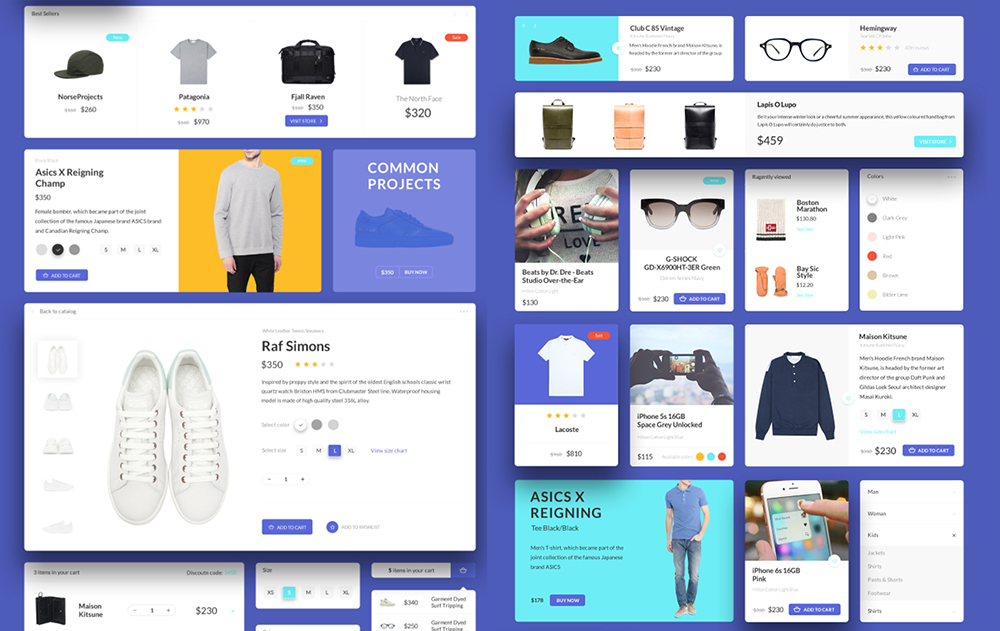
There are many great UI kits available today which adopt best practises, such as the above from UI8.net. These kits, which are easily styled and manipulated, give you tried and tested design functionality straight out of the box. Image credit: https://ui8.net/products/patagonia-ui
A high profile example of this came with Google’s 2014 launch of their Material Design Language – a set of design principles and guides which they developed to create a more consistent user experience.
They summarize the goal of Material Design to ‘develop a single underlying system that allows for a unified experience across platforms and device sizes. Mobile precepts are fundamental, but touch, voice, mouse, and keyboard are all first-class input methods.’
Google have implemented many of these principles within their own apps, and many other brands are adopting them for their own sites in order to enhance the experience for their users.
Our prediction: As these existing UI and UX patterns evolve and develop, we’ll see more and more brand’s implementing them as we move one step closer to a more unified, and consistent online browsing experience.
Keeping users happy with a streamlined UX is the top priority now as brand’s do away with design gimmicks in order to compete in an ever-increasingly more competitive market.